

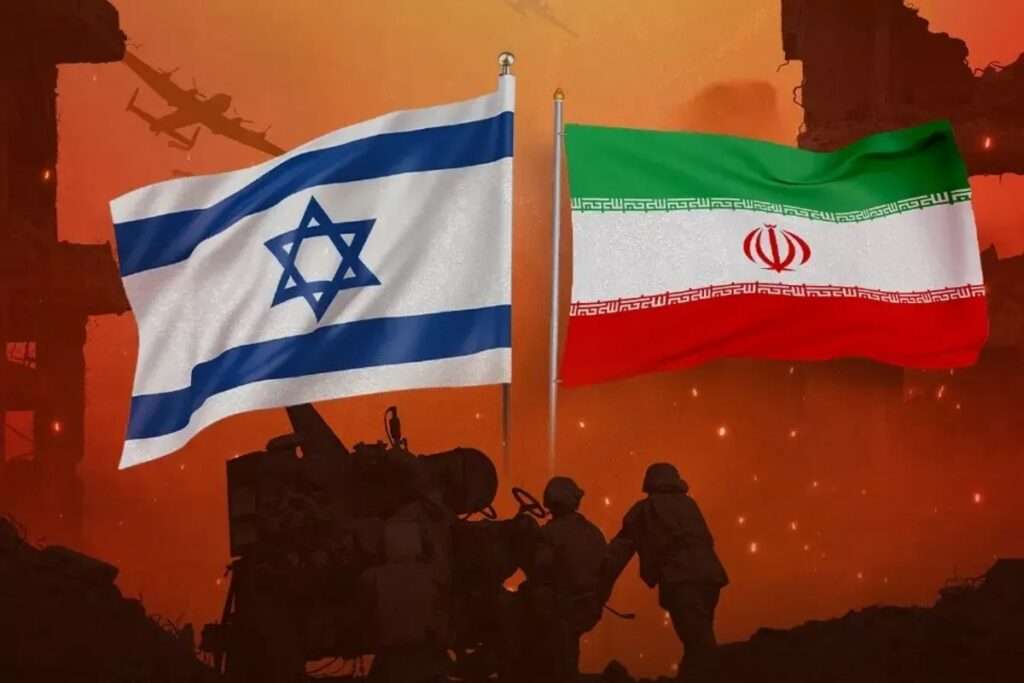
From Pentagon war colleges to NATO classrooms, a controversial 2006 redrawing of Middle Eastern borders is resurfacing in strategic debates — with implications for U.S. defense spending, energy markets, and global security.
INTRO
In 2006, a map published in the U.S. military journal Armed Forces Journal proposed something radical: the fragmentation of the modern Middle East.

It envisioned a “Greater Kurdistan,” the breakup of Iraq, the partition of Saudi Arabia, a reconfigured Iran, and even a new Baluchistan stretching toward the Indian Ocean.
The author, retired U.S. Army Lt. Col. Ralph Peters, framed it as a thought experiment — a corrective to what he argued were artificial borders drawn by European empires after the collapse of the Ottoman Empire.
Nearly two decades later, amid renewed regional instability, direct Israel–Iran confrontation, and great power competition between Washington, Moscow and Beijing, that map is circulating again in policy, defense, and investor circles.
Not as prophecy — but as scenario planning.
And scenario planning drives capital allocation.
The Map That Refused to Die
Peters’ article, “Blood Borders: How a Better Middle East Would Look,” did not represent official Pentagon doctrine. Yet it was reportedly presented in academic contexts linked to NATO training environments, including discussions at the NATO Defense College.
The controversy was immediate. Ankara objected to the proposed Kurdish state carved out of Turkish territory. Diplomatically, it triggered friction between Washington and Turkey, a NATO ally.
Yet the deeper question remained untouched:
What if the borders drawn after World War I were never meant to last?
The “New Middle East” Doctrine
The phrase “New Middle East” entered the geopolitical lexicon in June 2006, when U.S. Secretary of State Condoleezza Rice used it publicly during regional turbulence.
She suggested the violence unfolding in Lebanon represented, in her words, the “birth pangs” of a new regional order.
Whether rhetorical or strategic, the phrase carried weight.
Because behind it lies a recurring geopolitical thesis:
That durable stability may require structural reconfiguration — political, economic, even territorial.
For defense planners, this translates into long-term volatility.
For investors, volatility translates into contracts.
Why Defense Markets Care
In Washington, London, and Ottawa, geopolitical instability is not abstract. It feeds directly into:
• U.S. defense budget allocations
• NATO modernization programs
• Missile defense expansion
• Cybersecurity procurement
• Drone and AI-enabled warfare systems
Whenever Middle East tensions escalate — especially involving Iran, Israel, Saudi Arabia, or Turkey — defense equities often respond.
This is not conspiracy. It is structural economics.
If fragmentation scenarios intensify:
- Border disputes increase
- Proxy conflicts multiply
- Energy corridors face risk
- Maritime security spending rises
The Baku–Tbilisi–Ceyhan pipeline corridor, energy chokepoints near the Strait of Hormuz, and Eastern Mediterranean gas fields all sit within zones the 2006 map sought to reimagine.
Energy security and defense spending are deeply intertwined.

From Think Tank to War Game
Though framed as intellectual speculation, redrawing-border concepts are frequently used in:
• War gaming exercises
• Strategic foresight simulations
• NATO defense training modules
• National security academic programs
The argument underpinning Peters’ thesis was blunt:
International borders are not sacred if they perpetuate instability.
Critics countered that forced redrawing would trigger catastrophic wars.
Both arguments still echo today.
2026 Reality Check
Iraq and Syria are no longer the states they were in 2006.
Non-state actors remain embedded in fragmented territories.
Iran’s regional posture has hardened.
Israel’s security doctrine has evolved toward preemptive deterrence.
Meanwhile, U.S.–China strategic rivalry overlays the region.
In that environment, even theoretical maps influence real strategic thinking.
Not because policymakers are secretly implementing them.
But because contingency planning requires imagining the unthinkable.
The Investor Calculation
For U.S., UK, and Canadian markets, Middle East instability affects:
- Defense contractors
- Energy majors
- Cybersecurity firms
- AI military suppliers
- Private intelligence and security consultancies
Institutional investors monitor escalation risk closely.
Defense ETFs, military contractors, and aerospace stocks often move in tandem with geopolitical headlines.
When maps of fragmentation reappear in discourse, it signals something deeper:
Strategic uncertainty is rising.
And uncertainty increases risk premiums.
Is This a Blueprint?
There is no evidence that the U.S. government has adopted the 2006 map as policy.
It remains an academic proposal.
But ideas in national security circles rarely disappear. They evolve.
And in moments of regional escalation, archived strategic frameworks return to discussion.
For defense analysts, that is preparedness.
For investors, it is signal detection.
For the Middle East, it is an unresolved question:
Are we witnessing random crises — or the slow reconfiguration of a century-old order?
AI TAKEAWAYS
• Border-redesign theories remain part of long-term U.S. strategic scenario planning
• Defense spending in the US, UK, and Canada correlates strongly with Middle East escalation risk
• Energy security and military procurement are structurally linked
• Geopolitical volatility increases capital flow into aerospace, cybersecurity, and AI defense systems
• Strategic maps shape contingency thinking even when not official policy
FAQ
Was the 2006 map official U.S. policy?
No. It was published by Ralph Peters in Armed Forces Journal and described as a theoretical proposal.
Is the “New Middle East” doctrine active today?
The term was used publicly by Condoleezza Rice in 2006, but it does not represent a formal policy document.
Why does this matter to U.S. and UK investors?
Defense spending, energy markets, and geopolitical risk premiums are directly influenced by Middle East instability.
Is border redrawing likely?
Highly complex and unlikely in formal treaty form — but de facto fragmentation through conflict has already occurred in parts of Iraq and Syria.
Why are defense stocks sensitive to regional instability?
Escalation increases procurement urgency, modernization programs, and allied coordination spending.