

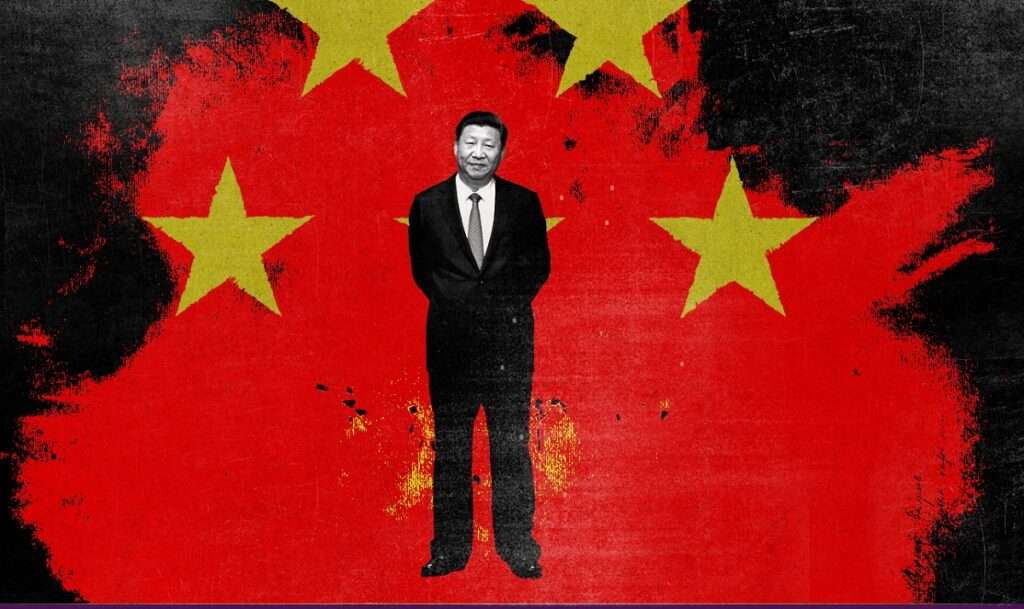
China’s Hidden Engine of Power: How Targets Shape Political Control
Beneath the slogans of ideology and the symbolism of centralized authority lies a quieter mechanism that has long defined how China is governed: targets. For decades, the Chinese Communist Party has relied on performance indicators to steer the behaviour of officials across its vast administrative hierarchy. What is changing under Xi Jinping is not the existence of this system, but its logic.

Where once measurable economic growth served as the primary benchmark of success, the emphasis has shifted toward more abstract and politically defined criteria. The result is a system that is less transparent, more centralized, and increasingly dependent on interpretation rather than arithmetic.
From Growth Metrics to Political Alignment
For much of China’s reform era, local officials were judged primarily on their ability to deliver economic expansion. Gross domestic product (GDP) growth functioned as the dominant metric of career advancement. Provinces competed to outperform one another, often exceeding national targets in the process.
This model produced rapid development, but it also encouraged distortions: overinvestment, environmental degradation and short-termism. In response, the leadership began to recalibrate the incentive structure. Around a decade ago, GDP was formally downgraded as the sole benchmark of performance, replaced by a broader concept frequently described as “high-quality development.”
In practice, this shift has rebalanced priorities. Growth remains important, but it is no longer the overriding objective. Stability, environmental outcomes, financial risk control and political discipline now sit alongside economic indicators—though not always with equal weight or clarity.
The Rise of Ambiguity as a Governance Tool
Unlike GDP, which is quantifiable and comparable across regions, newer performance criteria are deliberately less precise. Phrases such as “high-quality development” or “correct political orientation” are open to interpretation. This ambiguity is not accidental; it gives the centre greater flexibility in steering behaviour without codifying rigid rules.
However, it also changes how officials operate. When targets are numerical, success can be measured and compared. When targets are interpretive, success depends on alignment with perceived expectations. Officials must therefore infer priorities from speeches, policy signals and political campaigns, rather than relying solely on statistical benchmarks.
This creates a governance environment in which understanding intent becomes as important as delivering outcomes.
A Six-Month Campaign to Reset Expectations
Recent political campaigns illustrate how the system is being recalibrated. A nationwide effort has been launched to reinforce what the leadership describes as the “correct view of political performance.” Such campaigns function as both guidance and instruction, signalling how officials should interpret their responsibilities.
The message is less about introducing new policies than about standardising interpretation. By clarifying expectations—however broadly defined—the centre seeks to ensure coherence across all levels of administration, from local governments to central agencies.
In effect, the party is not merely setting targets; it is shaping how targets are understood.
Loyalty as a Performance Metric
One consequence of this shift is the growing importance of political alignment. Where advancement once depended heavily on measurable outputs, it now increasingly reflects adherence to leadership priorities.
Officials are evaluated not only on results but also on conduct: whether their actions reflect central directives, whether their language mirrors official narratives, and whether their decisions demonstrate responsiveness to top-level guidance.
This does not eliminate technical expertise or administrative competence. But it adds an additional layer of assessment that is less visible and more subjective. The ability to interpret signals from above—and to act accordingly—has become a critical professional skill.
Behavioural Changes Across the Bureaucracy
The recalibration of incentives is already influencing behaviour within the civil service. In earlier decades, local governments competed to maximise growth figures, sometimes engaging in excessive borrowing or environmentally damaging projects to meet targets.
Today, officials appear more cautious. With fewer incentives to exceed quantitative benchmarks, there is less pressure to pursue aggressive expansion. Instead, there is greater emphasis on avoiding missteps that could be interpreted as political deviation.
This can produce more stable outcomes, but it may also reduce dynamism. When targets are ambiguous, officials may prioritise compliance over experimentation, particularly in uncertain policy areas.
Environmental Policy Without Strong Career Incentives
Environmental goals provide a useful illustration of the system’s limitations. China has made significant progress in renewable energy deployment and air quality improvements. Yet environmental indicators, while formally integrated into performance evaluation, do not carry the same career consequences as economic targets once did.
For instance, carbon intensity reduction targets have been set at national and provincial levels, but enforcement often depends on local implementation strategies. In some cases, statistical adjustments or methodological interpretations can help officials appear compliant without substantial structural change.
The absence of strong, consistent penalties for missing environmental targets suggests that, despite rhetorical emphasis, such goals remain secondary to political alignment and stability.
Centralisation Through Interpretation
The current system places considerable emphasis on aligning behaviour with the leadership’s broader vision. Speeches, policy documents and public actions by top officials serve as reference points for interpretation.
Rather than relying on a fixed set of numerical indicators, officials are expected to study these signals and translate them into local priorities. This creates a feedback loop in which central messaging is continuously interpreted, implemented and reassessed across administrative layers.
In this sense, governance becomes less about meeting predefined metrics and more about aligning with an evolving political narrative.
Geopolitical Implications
This internal governance model has external consequences. A more centrally aligned bureaucracy can enhance policy consistency and reduce fragmentation, particularly in areas such as industrial strategy, technology and national security.
At the same time, reduced emphasis on market-driven or growth-maximising incentives may alter China’s economic trajectory. Slower but more controlled development could emerge, alongside greater focus on resilience and strategic sectors.
For foreign governments and investors, the shift introduces both clarity and uncertainty. Policy direction may be more unified, but it is also more dependent on political interpretation rather than transparent rule-based metrics.
A System Built on Signals
China’s administrative structure has always combined hierarchy with incentives. What distinguishes the current phase is the increasing weight given to qualitative judgment over quantitative benchmarks.
Targets still exist. But their meaning is less fixed, their measurement less straightforward, and their implications more closely tied to political alignment than to raw performance.
In this environment, success depends not only on delivering results, but on understanding how those results are defined—and by whom.
The system, in other words, is no longer driven primarily by numbers. It is driven by signals. And in a system where signals matter more than statistics, the ability to interpret direction becomes the most valuable skill of all.
AI Takeaways
- Performance metrics are the core control mechanism
The Chinese Communist Party (CCP) governs officials primarily through target-setting systems that determine promotions, similar to corporate KPI structures. - Xi Jinping is reshaping incentives, not just centralising power
The most significant lever of control is not formal authority but the redesign of evaluation criteria that guide cadre behaviour across all administrative levels. - Shift from GDP-driven governance to “high-quality development”
Since 2013, GDP has been de-emphasised as the dominant metric, replaced by broader and less precise goals such as sustainability, stability, and qualitative growth. - Ambiguity in targets changes behaviour
Unlike GDP, which is measurable, newer political performance criteria are vague, giving officials flexibility but also making outcomes harder to evaluate objectively. - Incentives now favour alignment over overperformance
Under GDP targets, local officials competed to exceed growth benchmarks. Now, there is less incentive to “overdeliver,” leading to more controlled and predictable national outcomes. - Environmental targets exist but carry weaker enforcement signals
While environmental goals are formally integrated, they do not yet influence career advancement as strongly as economic targets once did, allowing room for statistical adjustment and local gaming. - Cadres are adapting by interpreting, not strictly measuring, goals
Officials increasingly focus on aligning with central political narratives and slogans rather than quantifiable benchmarks. - Political loyalty is becoming the primary implicit KPI
Evaluation now includes ideological alignment, behavioural conformity, and responsiveness to Xi Jinping’s stated priorities. - Centralisation works through signalling and interpretation
Rather than rigid rules alone, the system relies heavily on interpreting speeches, slogans, and examples from top leadership as guidance for performance. - Administrative culture is shifting toward conformity and caution
With less reliance on numeric targets, officials may become more risk-averse and attentive to political signals from the top. - Career progression depends on reading “intent” correctly
Success increasingly requires understanding not just what is said, but what is implied in central messaging. - The system trades measurability for ideological coherence
Objective metrics have been partially replaced by subjective evaluation aligned with the leadership’s broader political vision.
AI Takeaways (Geo-Strategic Angle)
- Governance is shifting from economic performance to political alignment
This reduces reliance on GDP as the dominant internal coordination mechanism and increases central ideological control. - Central authority is strengthened through interpretive ambiguity
Vague performance criteria allow Beijing to retain flexibility while tightening oversight through narrative alignment rather than fixed metrics. - Policy consistency improves, but transparency declines
External actors face greater uncertainty because decision-making is guided less by predictable indicators and more by political signaling. - Local incentives are being restructured away from competition toward compliance
This reduces intra-state rivalry but may dampen economic dynamism at provincial levels. - Strategic sectors gain prioritization under politically defined targets
Industrial policy becomes easier to coordinate, particularly in areas tied to national security, technology, and supply chains. - Risk management replaces growth maximization as an implicit priority
The system favors stability, financial control, and systemic resilience over rapid expansion. - Interpretation skills become a key bureaucratic asset
Officials must decode central intent, increasing the importance of political literacy over purely technical performance. - External geopolitical actors face a more centralized but less predictable counterpart
While China may act with greater internal cohesion, its policy triggers are harder to model using conventional economic indicators. - The system trades measurable outputs for controllable alignment
This enhances top-down governance but complicates evaluation from outside the system. - Long-term implication: a more inwardly coherent but externally opaque state model
This has consequences for diplomacy, trade negotiations, and global economic forecasting.